NERC CIP-003-9

Operational Insight & Threat Detection for Connected Infrastructure
Low Impact doesn't mean Low Risk
Low Impact assets represent one of the largest and least protected attack surfaces in critical infrastructure.
WHAT IS CIP-003-9
NERC CIP-003-9 is a part of the broader NERC CIP framework, which governs cybersecurity for North American electric utilities. 003-9 specifies security management controls for Bulk Electric System (BES) environments, with a focus on Low Impact assets. It defines foundational controls around governance, access, and monitoring to protect grid reliability, most notably establishing controls for vendor electronic remote access.
Low Impact BES Cyber systems have historically been less monitored with no minimum security baselines, but are critical in nature and can collectively be targeted for coordinated attacks.
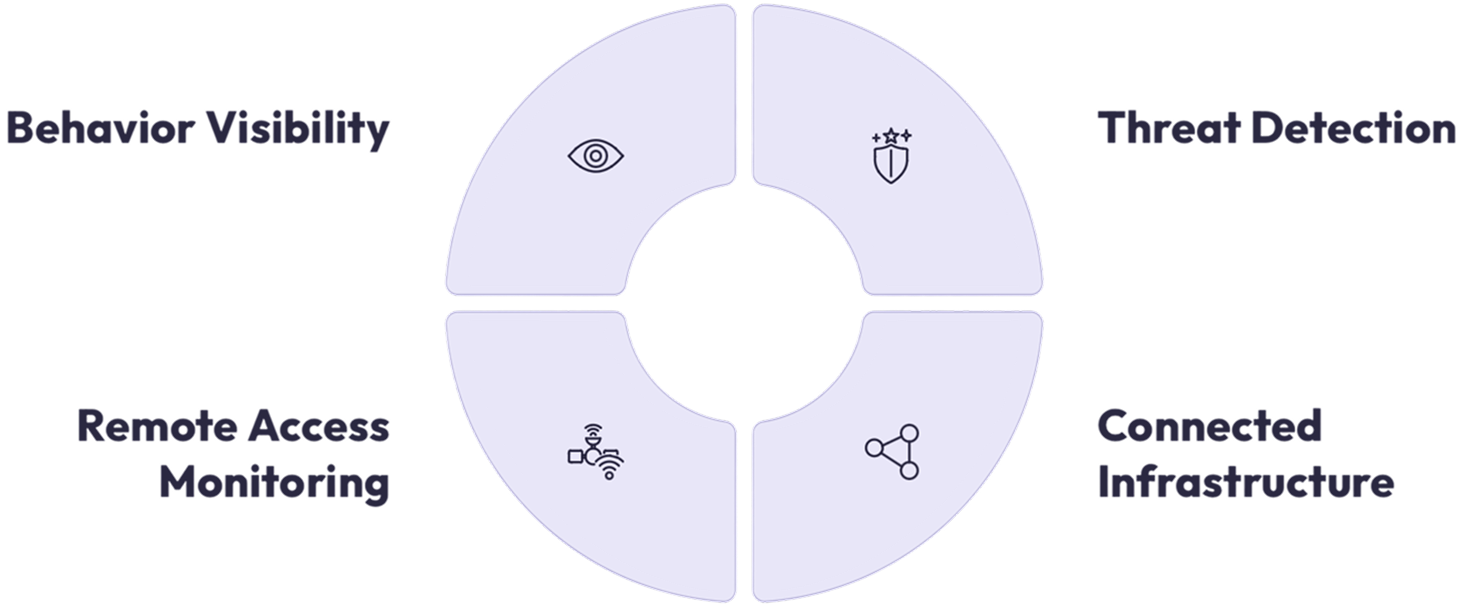
Closing the visibility and control gap at Low Impact sites aligns with the pillars of operational security.
WHO IT APPLIES TO
If your organization operates low-impact grid assets, you are likely in scope.
Low Impact BES Cyber System owners
- Small Generation Resources
- Substation and transmission stations
- Small, "low impact" control centers or substations using Remote Terminal Units (RTUs), Programmable Logic Controllers (PLCs)
- Ancillary Network equipment like IoT devices that support local control
- Physical security systems in building automation systems (BAS) such as badge access control or security cameras
The smaller the system, the more likely it is for it to be remotely managed.
Organizations in Scope
Organizations in Scope
- Electrical distribution providers
- Electrical generator owners and operators
- Electric transmission owners and operators
- Utilities
- Independent power producers
- Municipal utilities
- Public power and co-ops
HOW IOLITE HELPS
Designed for distributed infrastructure

Baseline + Anomaly Detection
Detect deviations across cyber-physical behavior including unapproved communications & network behavior

Custom Detection Logic
Identify suspicious communication patterns and malware-like behavior

Incident Response
Build pre-approved processes and controls directly into your detection and monitoring systems

Vendor Electronic Remote Access Security Controls
Monitor for electronic remote access behavior and logging, and detect known or suspected inbound and outbound malicious communications

Physical Layer Connectivity
Monitor industrial events like temperature, pressure, humidity, and more or disconnected cables, or unexpected behavior
Lightweight Footprint
Runs on minimal hardware (even edge devices)
Air-Gapped Operation
Fully functional with no cloud connectivity
Hardware Agnostic
Works across diverse OT, IT and IoT environments
KEY REQUIREMENTS
Parties need to document and review cyber security policies that collectively address:
Cyber Security Awareness
Physical Security Controls
Electronic Access Controls
Cyber Security Incident Response
Transient Cyber Assets & Removable Media Malicious Code Risk Mitigation
Vendor Electronic Remote Access Security Controls
Declaring and Responding to CIP Exceptional Circumstances

WHERE ORGANIZATIONS STRUGGLE
Low Impact doesn't mean Low Risk
Low Impact assets represent one of the largest and least protected attack surfaces in critical infrastructure.
Compliance requires more than documentation. It requires visibility.
Asset Owners Face Operational Challenges
- Limited visibility into distributed assets
- Air-gapped or offline environments
- IT-centric tools that don't translate to OT
- High cost of scaling traditional monitoring
Even with policies in place, most organizations lack:
- Visibility into vendor activity
- Monitoring at Low Impact sites
- Real-time threat detection across OT environments
Competitor Comparison
Operational Insight & Threat Detection for Connected Infrastructure


.svg)